By Lucas Gray | Professional Gaffer & Cinematographer
It’s been a rainy month in Vancouver—even by our standards. When you are shooting interiors day after day, fighting the gloom outside, you need tools that are versatile. You need punch, you need color, and increasingly, you need to not break the production budget.
For years, if you wanted a high-output RGB spotlight, you had to pay a “color tax.” You either bought a heavy, expensive Arri Orbiter, or you settled for weaker 150W or 300W fixtures that just couldn’t fight a window.
Enter the Nanlite FC-500C.
On paper, this thing looks like a disruptor: 500 Watts of full-color output, Green/Magenta shift, and a price tag sitting around $719. That is dangerously cheap. Is it too good to be true? Is it just a plastic toy, or can it survive on my grip truck?
Here is my field-tested review of the Nanlite FC-500C.
What Exactly is the “FC” Series?
Before we dive into the Nanlite FC 500C, we need to understand where it sits. Nanlite has the Forza series (the rugged, metal-build workhorses) and the FS series (the studio-only, all-in-one plastic bodies).
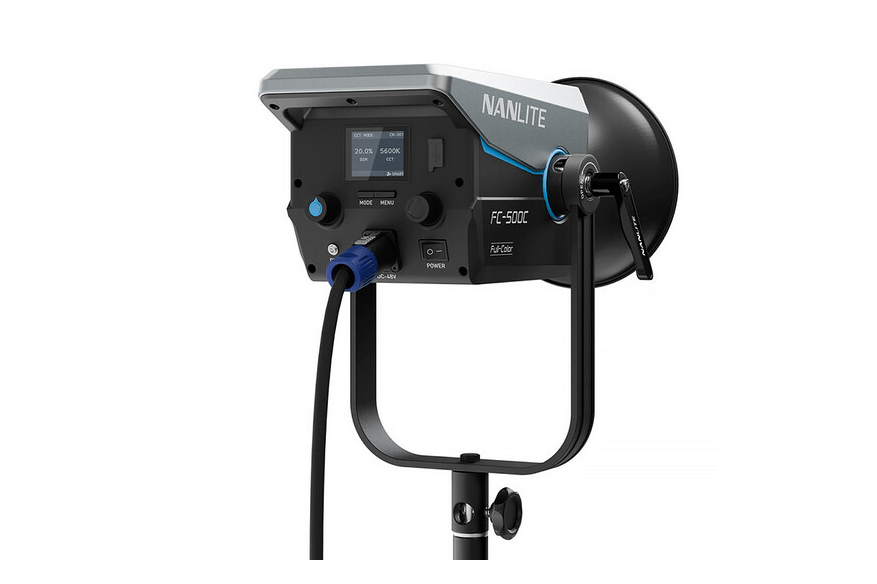
The FC series sits weirdly in the middle. It has a separate power supply (like a Forza) but a more composite, stylish body (like an FS/Amaran hybrid). Nanlite calls it “Stylish.” I call it “I hope it doesn’t crack if my 2nd AC drops it.”
But honestly? For the price, I’m willing to overlook the aesthetics if the light quality delivers.
1. Output: The 500W Sweet Spot
Let’s talk power. As I always say, I can dim a bright light, but I can’t make a dim light brighter.
The Nanlite FC 500C claims to output 57,050 Lux at 1 meter (3.3 ft) with its included reflector at 5600K.
In the real world, that is a lot of light. It sits right in that sweet spot where it’s significantly punchier than a 300W fixture (like an Amaran 300c or Forza 300), allowing you to actually bounce it or diffuse it heavily and still get exposure.
I used it recently on a corporate interview setup. We were shooting in a room with mixed practicals. I needed to blast the FC-500C into a bleached muslin bounce to create a soft key. At 100%, it was actually too bright. I had to dim it down to 65%. having that headroom feels like a luxury at this price point.
2. Color Engine: RGBW and That “Green/Magenta” Shift
This is the first RGBW light in the FC line, and Nanlite didn’t hold back.
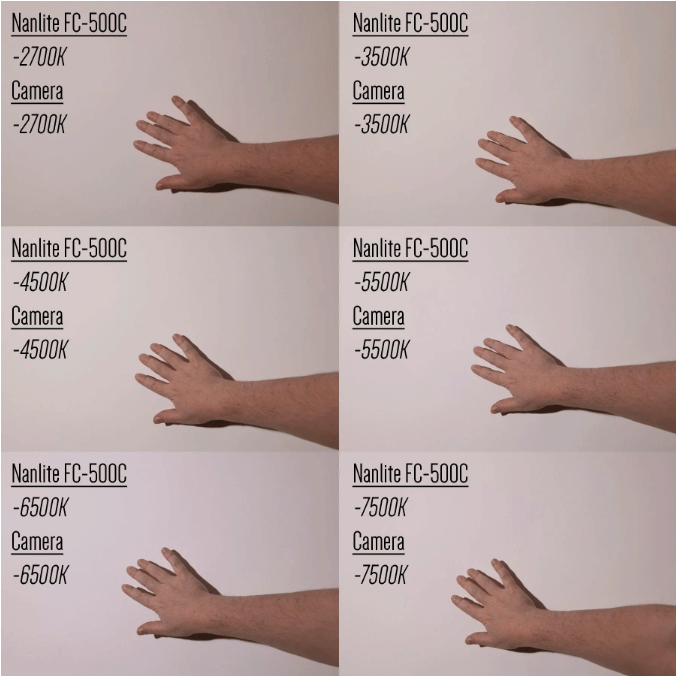
The CCT range is solid: 2700K to 7500K. But the real killer feature for me is the Green/Magenta Shift (+/- 150).
Why does this matter?
If you are shooting in an old office building with nasty, green-tinted overhead fluorescent lights that production won’t let you turn off, you are usually screwed. Your beautiful 5600K daylight LED looks magenta by comparison.
With the Nanlite FC 500C, I can dial in just enough “plus green” to match the ambient nastiness, and then white balance the camera to clean it all up. It saves hours in post-production.
The color specs are respectable for the price:
- CRI: 95
- TLCI: 94
- SSI (5600K): 71
- SSI (3200K): 84
While an SSI of 71 at daylight isn’t industry-leading (we usually like to see mid-70s or 80s), for broadcast, YouTube, and corporate video, it is more than acceptable. Skin tones looked healthy, not waxy.
3. The Design: The “Wing” and the Build
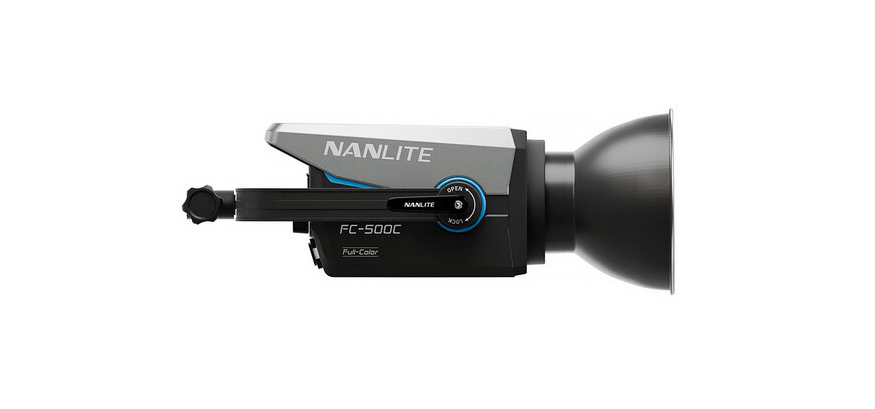
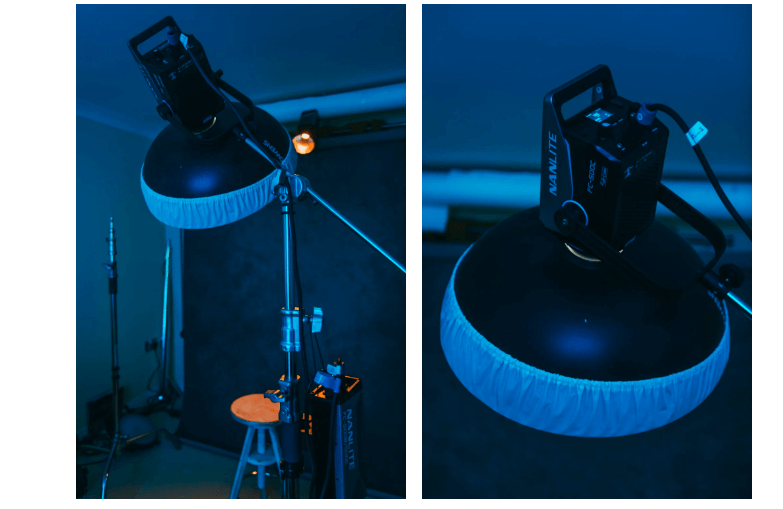
The head features a “wing-shaped top housing.” Nanlite marketing says it’s stylish; I say it’s effective heat dissipation.
The fan noise is manageable. It has Smart Fan Modes, which is essential when you have a lavalier mic three feet away from the light stand. It hasn’t ruined an audio take for me yet.
The yoke is a single-sided lock. I usually hate these because they tend to slip when you put a heavy softbox on them. However, this one allows for 360° rotation, which is nice. Just be careful if you are rigging a massive 5-foot Octabox; crank that handle tight.
Size & Weight:
The head weighs 3.91 kg (8.6 lb). It’s light enough to boom out on a menace arm without needing a massive counterweight ecosystem. It’s definitely “Travel-Ready,” especially with the included hard foam case.
4. The Power Problem (My Main Gripe)
Here is where the “Budget” nature of the Nanlite FC 500C shows its face.
Out of the box, this is an AC-powered light. It comes with a power brick (Power Supply) and cables. Great for studio work.
But what if you want to use batteries?
Unlike the Forza series, the battery plates are not built into the ballast.
If you want to run this on V-Mount batteries, you have to buy a separately available FC PowerController.
This drives me crazy. It’s another piece of gear to buy, another piece of gear to lose, and another cable connection to fail. If you are strictly a studio shooter, this doesn’t matter. But if you are a location shooter like me, factor the cost of that controller into your purchase price.
5. Connectivity and Control
For control, Nanlite gives you plenty of options:
- Onboard Knobs: Intuitive, with a decent 2-inch screen.
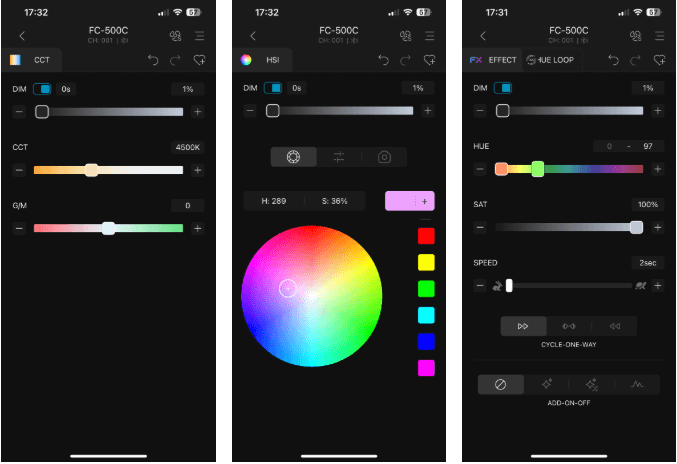
- Bluetooth (NANLINK App): The app is actually quite stable now. I use it on my iPad to cue effects or adjust ratios from the camera.
- DMX/RDM: It has a locking metal 3.5mm port. It’s good that it’s there for when we tie it into a lighting console, though I prefer 5-pin XLR. You’ll need adapters.
The Lighting Effects are standard fare—Hue Loop, TV, Paparazzi, Welding, etc. They are useful for music videos or narrative dream sequences.
6. Bowens Mount: The Universal Standard
Thank goodness. It uses a standard Bowens Mount.
This opens you up to the entire ecosystem of affordable modifiers. You can use the Aputure Lantern, Godox softboxes, or Nanlite’s own Para series. It also includes an umbrella holder, which is a nice throw-back touch for fast news-gathering setups.
Comparisons: The Landscape
Nanlite FC-500C vs. Amaran 300c:
The FC-500C destroys the 300c in output (500W vs 300W). If you need to fight the sun or light a large space, the Nanlite wins. The Amaran is cheaper and smaller, but the extra punch of the FC-500C is worth the extra cash.
Nanlite FC-500C vs. Forza 500 II:
The Forza 500 II is a tank. It’s daylight only (or bi-color), superior build quality, and has battery plates built-in. But it lacks Full RGB. If you need color and power, the FC-500C is the unique hybrid.
Technical Specifications
Here are the numbers you need to know:
| Feature | Specification | Notes |
| Output | 500W | |
| Brightness | 57,050 Lux @ 1m | 5600K w/ Reflector |
| CCT Range | 2700K – 7500K | G/M Shift Adjustment |
| Color Modes | RGBW, HSI, Gel Presets | 36,000 Colors |
| CRI / TLCI | 95 / 94 | High Fidelity |
| Mount | Bowens Mount | Universal |
| Head Weight | 3.9 kg / 8.6 lb | Lightweight Composite |
| Power Source | AC (Included) | V-Mount requires separate controller |
| Control | Onboard, App, DMX | 2.4G & Bluetooth |
| Price | ~$719.00 | Excellent Value |
Final Verdict: Who is the Nanlite FC 500C For?
The Nanlite FC 500C is a confusing product in the best way possible. It offers professional-grade output and color features at a price that feels like a mistake.
Buy this light if:
- You are a content creator, YouTuber, or corporate videographer who needs a bright key light that can also serve as a colored background light.
- You work primarily in studios or locations with reliable AC power.
- You need the versatility of Green/Magenta shift to match house lights.
Skip this light if:
- You are a “Run and Gun” doc shooter who relies 100% on batteries (the external controller requirement is annoying).
- You abuse your gear. The build is decent, but it’s not a metal Forza.
For my money, the Nanlite FC 500C has earned a spot on the “B-Roll Truck.” It’s the light I grab when I need to add a splash of color to a background or when I need a powerful, lightweight key for an interview and don’t want to haul the heavy HMI cases up the stairs. It punches way above its price class.
Lucas Gray is a gaffer based in Vancouver, BC. He has way too many Bowens mount softboxes and drinks his coffee black.