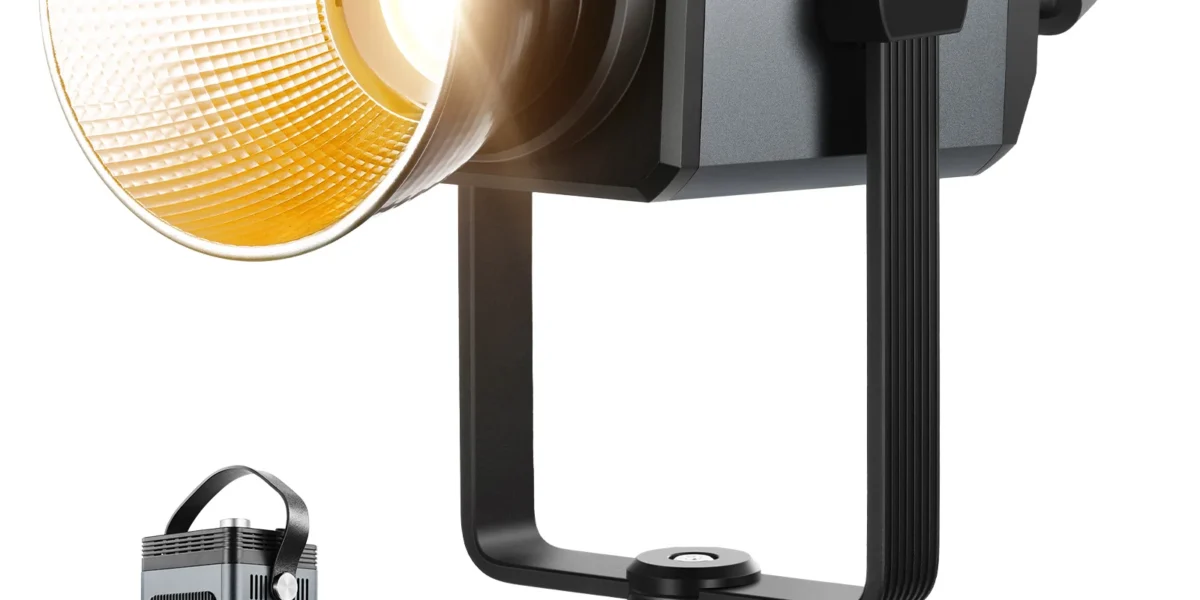
Verdict: The NEEWER AS600B is a 600W bi-color continuous light built for one purpose—maximum raw output at a price that undercuts the established brands. If that is what you need, it is hard to beat. If you need RGB, portability, or a streamlined workflow, this continuous LED light is not for you.
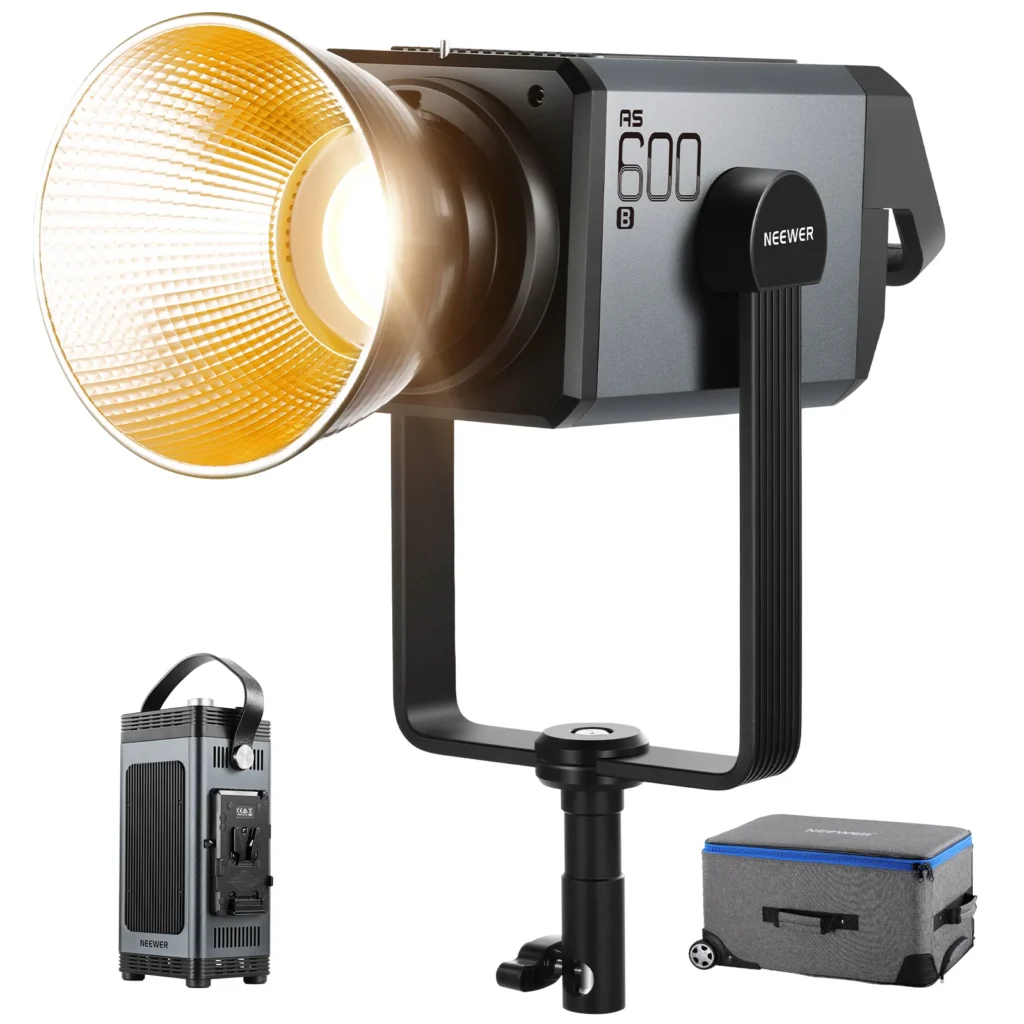
The NEEWER AS600B sits in an unusual position in today’s continuous lighting market. At $599 (discounted from $899), it promises 600W of bi-color output for roughly half what premium brands charge for comparable power. That is a tempting proposition for anyone building a continuous light setup on a budget. It is also, deliberately, not the whole story.
This review examines what this continuous light does well, where it cuts corners, and whether those compromises matter for your work.
Product Information
| Specification | Detail |
|---|---|
| Model | NEEWER AS600B |
| Type | Bi-Color COB LED Continuous Light |
| Maximum Power | 600W |
| Color Temperature | 2700K–6500K |
| CRI / TLCI | 96+ / 98+ (claimed) |
| Measured CRI (5600K) | 96.0 (R1–R8), 95.04 extended |
| Maximum Illumination | 99,000 lux @ 1m (standard reflector); 200,000 lux @ 1m (optional spot reflector) |
| Mount | Bowens S-Type |
| Control Methods | Onboard, DMX, 2.4G wireless, NEEWER App |
| Power Options | AC adapter; 2× V-Mount batteries (not included) |
| Fan Modes | Auto, Low, High, Silent |
| Lamp Dimensions | 510 × 235 × 155mm / 20 × 9 × 6 in |
| Lamp Weight | 5kg / 11 lb |
| Kit Weight (with case) | Approx. 18kg / 40 lb |
| Price | $599 (sale); $899 (regular) |
What Makes This Continuous Light Stand Out: Output
The AS600B’s defining characteristic is its 600W output, and independent testing confirms it is not merely a marketing figure. Digital Camera World’s reviewer, who has tested numerous continuous LED lights, stated that the AS600B “blows all the other LEDs I’ve tested out of the water” in terms of output intensity. At 1 meter with the included reflector, NEEWER claims 99,000 lux. Even accounting for optimistic manufacturer measurements, the real-world brightness is substantial enough to serve as a key light in medium-to-large studios or as a powerful fill in demanding commercial environments.
Color accuracy, at least at the temperatures that matter most for interview and narrative work, holds up reasonably well. Newsshooter’s independent testing recorded an average CRI (R1–R8) of 96.0 at 5600K and an impressive 97.8 at 3200K. Skin-tone relevant metrics were strong: R13 measured 96.5 at 5600K, and R15 measured 94.5. These are not class-leading numbers—the Nanlite Forza 500B II and Aputure LS 600x both score higher on extended CRI—but they are entirely serviceable for most production work with a continuous light.
Dimming linearity is also commendable. Newsshooter’s testing showed that at 50% output, the light produced 49.57% less output than at full power, and CCT drift across the dimming range was only 119K. This means the continuous light behaves predictably as you dial it down, which matters when matching fixtures or making subtle adjustments on set.
The control suite is generous for the price point. DMX in/out, 2.4G wireless, and app control cover everything from single-operator setups to multi-fixture studio environments. The Bowens mount opens access to the vast ecosystem of affordable modifiers, and the included trolley case, while heavy, protects the investment during transport.
The Trade-offs of a $599 Continuous LED Light
Weight and Portability
The AS600B is not a continuous light you casually throw in a backpack. The lamp head alone weighs 5kg. The separate controller box adds another 3.74kg. The complete kit in its trolley case tips the scales at just under 18kg (approximately 40 lb). Digital Camera World’s reviewer noted that transporting the case to a studio required using an elevator rather than carrying it up stairs—a first in their experience of reviewing continuous lighting kits.
The split head/controller design is functionally justified. At 600W, integrated power management becomes impractical, and the external box enables V-mount battery operation for location work. But it does mean setup and teardown involve more steps: connecting the head to the controller, positioning the controller (it includes a super clamp for stand mounting), and managing the additional cable. For solo shooters who value speed and simplicity, this friction adds up.
No RGB, No Green/Magenta Shift
The AS600B is strictly bi-color. It covers 2700K to 6500K, which handles the vast majority of traditional continuous lighting needs. But it offers no RGB output for creative color effects, and critically, no green/magenta tint correction. For narrative work where you might need to match practicals with a slight green spike, or for any application requiring colored light, this continuous light simply cannot deliver. NEEWER’s own product line includes RGB options (CB200C, CB300C, FS600C) at comparable or lower price points, which makes the omission a deliberate positioning choice rather than a technical limitation.
The Constant Brightness Mode Catch
The AS600B offers two operating modes: Maximum Power Output and Constant Brightness. In Maximum Power mode, the continuous light delivers its full 600W, but brightness will fluctuate slightly as you change color temperature—this is inherent to how bi-color COB arrays blend warm and cool LEDs. In Constant Brightness mode, the light maintains consistent output across temperatures, but the maximum achievable brightness drops significantly.
This is not a flaw unique to NEEWER; it is physics. But buyers should understand that the headline 99,000 lux figure is only available in Maximum Power mode. If your workflow demands consistent exposure while dialing color temperature, you will be working with considerably less output from this continuous light.
Blue Accuracy
Newsshooter’s testing revealed a notable weakness: R12 (blue) scored only 76.5 at 5600K. This means saturated blues—think blue gels on background elements, or specific costume colors—may not render as accurately as other hues. It is a narrow limitation, but worth knowing if your work involves critical color matching with a continuous light.
Who Should Buy This Continuous Light
Buy it if:
- You need maximum raw output per dollar and your budget is firmly under $1,000. The AS600B competes on brightness with continuous lights costing significantly more.
- You work primarily in controlled environments—studios, interview setups, commercial sets—where the weight and split design are logistical inconveniences rather than dealbreakers.
- You already own Bowens-mount modifiers and want a powerful continuous light without rebuilding your accessory ecosystem.
- You need DMX control for integration into a larger lighting system, or V-mount battery operation for location work where AC power is unavailable.
Skip it if:
- Portability is a priority. At 18kg for the full kit, this is a vehicle-and-assistant continuous light, not a one-bag solution.
- You need RGB, green/magenta correction, or creative color effects. The AS600B cannot do these things, and NEEWER sells continuous lights that can.
- You prefer an integrated, streamlined workflow. The separate controller box adds setup time and cable management that some shooters will find frustrating.
- Color-critical work in saturated blues is part of your regular output.
Final Verdict: A Focused Continuous Light
The NEEWER AS600B is a focused tool. It does one thing exceptionally well—deliver a lot of accurate, flicker-free continuous light for the money—and it makes deliberate, visible compromises everywhere else. The weight, the split design, the absence of RGB: these are not oversights. They are the costs of hitting a $599 price point with 600W of output.
Whether that trade-off makes sense depends entirely on what you need from a continuous light. If you have been searching for an affordable key light that can genuinely fill a large softbox or illuminate a substantial set, the AS600B is difficult to beat on pure economics. If you need flexibility, color, and mobility, your money is better spent elsewhere—perhaps on two smaller continuous lights, or on NEEWER’s own RGB options.
It is not a continuous light for everyone. But for the right buyer, it is a lot of light for the money.