If you have spent as many years on freezing cold film sets in Vancouver as I have, you develop a love-hate relationship with heavy gear. For two decades, my life revolved around hauling massive 1.2K HMI pars and listening to the hum of diesel generators. We needed the punch, so we dealt with the weight.
Then, the LED revolution happened.
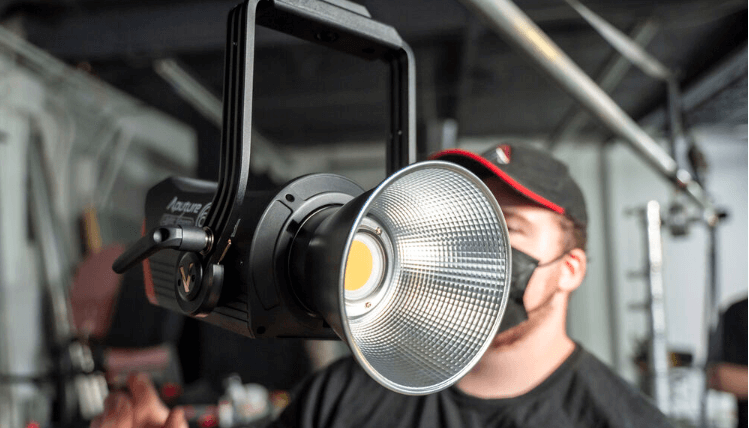
Today, I’m taking a deep dive into a fixture that is often overshadowed by its “Pro” big brother, but actually makes more sense for 90% of shooters: the Aputure LS 600d.
I’ve used this light on commercials, music videos, and indie features. While the internet obsesses over the “Pro” version, I’m going to tell you why this standard version might actually be the better buy for your studio.
The “Standard” vs. “Pro”: Why Weight Matters
Let’s address the elephant in the room immediately. Why buy the standard LS 600d instead of the 600d Pro?
The answer is weight.
As a gaffer, I am constantly rigging lights high up in grid systems or mounting them on boom arms (menace arms).
- The LS 600d Pro control box weighs a massive 5.8kg (12.79lbs).
- The Standard LS 600d control box weighs just 3.24kg (7.14lbs).
That is nearly 50% lighter. When you are trying to clamp a ballast to a light stand without it becoming top-heavy and tipping over, that 2.5kg difference is massive. It utilizes the same brightness, the same color quality, but in a package that is much easier to transport and rig.
1. Output and Brightness: Fighting the Sun
Let’s talk about the main reason you are Googling the Aputure 600d: raw power.
My number one rule is: I can always dim a light down, but I can’t make it brighter. You buy the 600d because you need to fight the sun or light a large diffusion frame.
According to the photometrics, this light is a beast:
- With Hyper Reflector: It outputs a staggering 98,500 lux @ 1 meter.
- At 3 Meters: It hits 8,500+ lux.
- With F10 Fresnel (Spot): An insane 224,200 lux @ 1 meter.
In the real world, this means I can place the 600d outside a window, blast it through the glass, and it will look like convincing sunlight hitting the talent inside. It rivals a traditional 1200W HMI but draws half the power (720W) and plugs into a standard wall outlet.
2. Build Quality and The Curved Yoke
Even though this is the “lighter” version, Aputure didn’t use cheap plastic. The lamp head is constructed from Magnesium Alloy. It feels industrial and ready for rental work.
One specific detail I appreciate is the Curved Yoke.
Many cheaper lights have a flat yoke. When you put a large modifier on them (like the Light Dome 150), the modifier hits the yoke, and you can’t tilt the light up.
The LS 600d uses a curved yoke design that allows for 360° tilt, even with large modifiers attached. It’s a small detail, but on a busy set, it saves me from cursing at the equipment.
3. Power Solutions: V-Mount Flexibility
The control box is the brain of the operation. It features dual V-Mount (or Gold Mount) battery plates.
If you are a run-and-gun filmmaker, you need to know the voltage limitations:
- Half Output (50%): You can power the light using standard 14.4V / 15A batteries (the ones you probably already own).
- Full Output (100%): To get the full 600W intensity on battery power, you need high-voltage 26V batteries or dual 14.4V batteries capable of high amperage.
For most location interviews, 50% output on this light is still brighter than most other lights on the market running at 100%.
4. The Ecosystem: Bowens Mount & Sidus Link
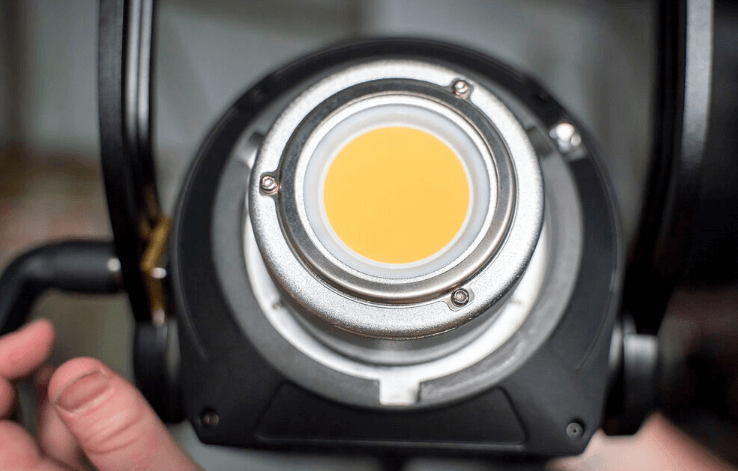
The LS 600d sticks to the universal Bowens Mount. This is crucial. It means you aren’t locked into expensive proprietary accessories. You can use the Aputure F10 Fresnel, Lantern 90, or a cheap softbox you bought on Amazon five years ago.
Sidus Link App Control:
I’m 40. I’m old school. I like physical knobs. But the Sidus Link app is undeniably good.
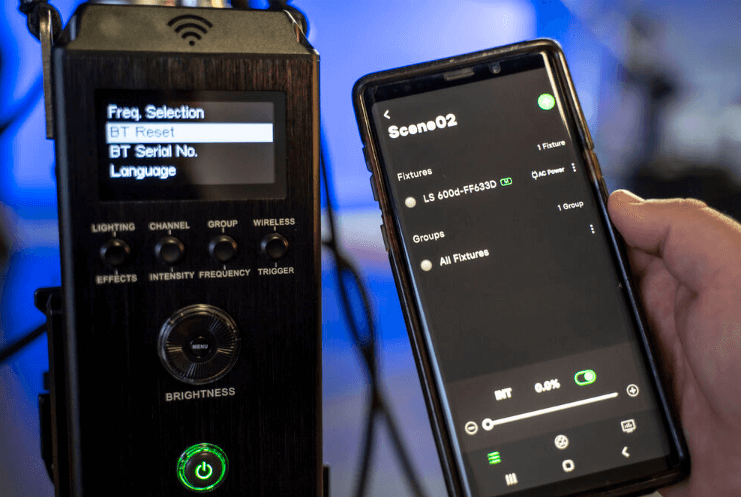
The LS 600d has built-in Bluetooth Mesh with a range of up to 80 meters. I can stand at the camera monitor with my iPad and adjust the key light, fill light, and hair light instantly. It supports all the standard lighting effects (Paparazzi, Fireworks, Lightning, etc.).
5. Technical Specifications Breakdown
For the gear nerds (like me), here are the hard specs for the Aputure LS 600d (Standard).
| Feature | Specification | Notes |
| CCT (Color Temp) | 5600K ± 200K | Daylight Balanced |
| CRI / TLCI | ≥96 / ≥96 | Professional Color Accuracy |
| Output (Reflector) | 98,500 lux @ 1m | Comparable to 1200W HMI |
| Max Power Draw | ≤720W | Safe for Household Circuits |
| Control Box Weight | 3.24kg / 7.14lbs | Highlight: ~50% lighter than Pro |
| Lamp Head Weight | 4.69kg / 10.34lbs | Magnesium Alloy Build |
| Battery Power | V-Mount / Gold Mount | Half Output (14.4V) / Full Output (26V+) |
| Dimming | 0-100% | Stepless (Linear, S-Curve, etc.) |
| Wireless Control | Sidus Link App, 2.4GHz | Bluetooth Mesh up to 80m |
| Fan Noise | Active Cooling | Very Quiet |
Comparison: Who is this for?
Buy the Aputure LS 600d (Standard) if:
- You mostly shoot indoors, in studios, or locations with cover.
- You value portability and want a lighter kit to carry.
- You want to save some money to spend on modifiers (like a Fresnel or Softbox).
- 👉 [Check Current Price of LS 600d]
Buy the Aputure LS 600d PRO if:
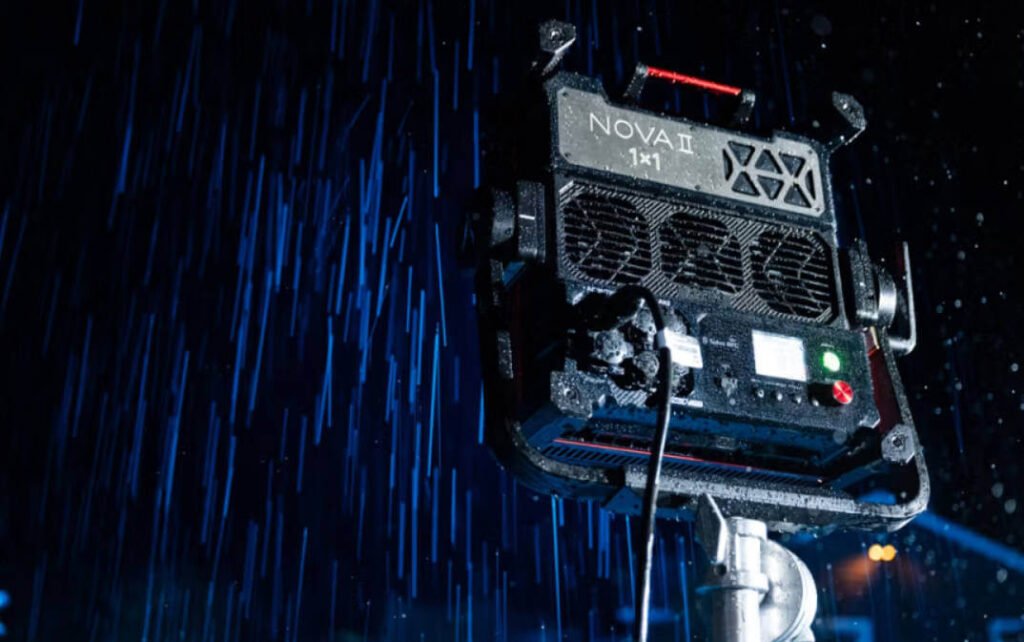
- You shoot outdoors in the rain (It has IP54 Weather Resistance).
- You use professional DMX consoles and need LumenRadio CRMX built-in.
- You don’t mind carrying a much heavier control box.
- 👉 [Check Current Price of LS 600d Pro]
Final Verdict
The Aputure 600d is a workhorse. It bridged the gap between consumer LED lights and high-end Hollywood HMI trucks. By stripping away the weather sealing of the Pro version, Aputure created a light that is easier to transport, easier to rig, and easier on the wallet, without sacrificing a single percent of brightness.
It sits permanently in my kit, usually right next to my coffee.
Lucas Gray is the lead writer for StudioLights.org and a working gaffer based in Vancouver. When he’s not lighting sets, he’s organizing his cable bag.