
The market for COB (Chip-on-Board) LED lights has become incredibly saturated. For creators, this is a double-edged sword. Prices are dropping and professional tech is trickling down, but it is becoming increasingly difficult to distinguish between professional production tools and over-hyped toys.
At StudioLights.org, we believe in data over marketing. We don’t just read the spec sheet; we look at real-world metrics like color accuracy (CRI/TLCI), fan noise floors, and thermal stability over long shoots. A light might be bright, but if it sounds like a jet engine or renders skin tones with a green tint, it is useless for professional video.
Below is our objective analysis of the top contenders for 2026: The innovator (Zhiyun), the color specialist (GVM), and the industry heavyweight (Aputure).
Best Compact High-Output
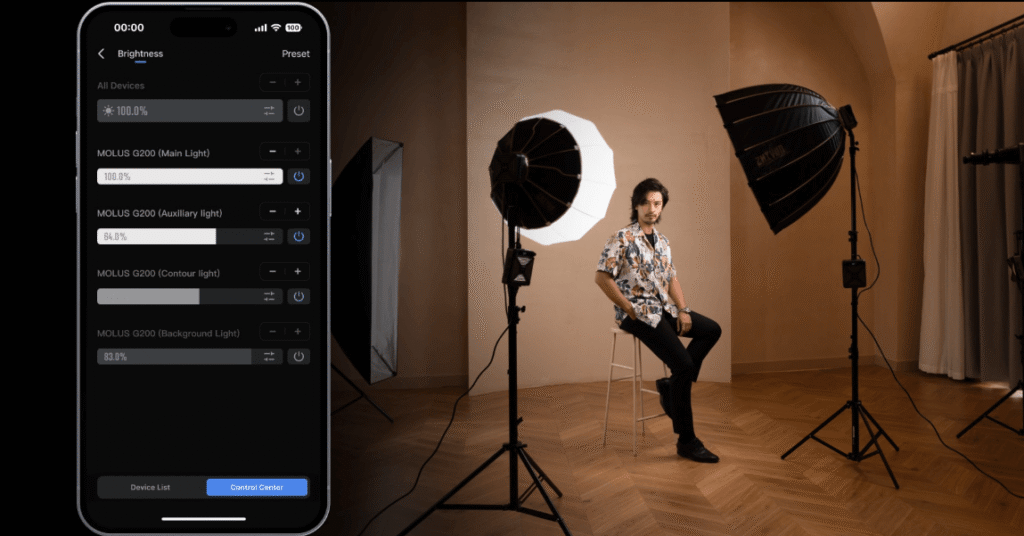
Zhiyun Molus G200
The Verdict: The Zhiyun Molus G200 attempts to solve a specific problem: getting high output (200W+) into a form factor that fits in a small backpack. It achieves this by separating the light head from the controller unit, a smart design that significantly reduces the weight on your light stand.
Its standout feature is the “MAX Extreme Mode,” which allows for a one-press overclock to 300W. While impressive for short bursts or fighting daylight, users must be aware that this pushes the cooling system to its limit, resulting in increased fan noise.
Output (1m) 9,460 Lux (Bare) / [🔴 Peak w/ Reflector]
CRI / TLCI ≥95 / ≥97
Cooling DynaVort System™
Mount Type Bowens Compatible
The Pros
- Unrivaled power-to-size ratio (Lightweight Film-grade material).
- Separated design keeps the light head compact (127mm x 67.5mm).
- “MAX Mode” provides a tangible brightness boost to 300W.
- Music Mode allows lighting to sync with beats.
The Cons
- Fan noise increases significantly in MAX mode.
- Requires a separate controller box (adds to cable management).
- Lacks DMX control for advanced studio integration.
Best Value for Color Accuracy
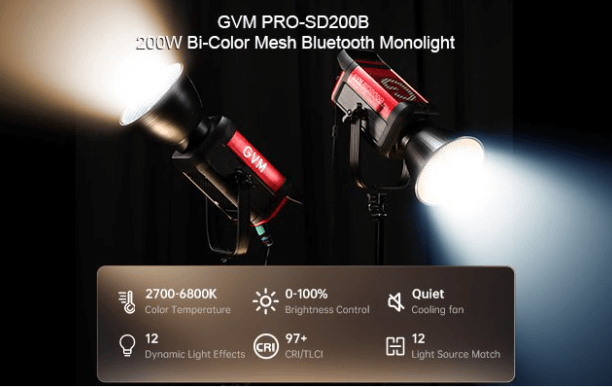
GVM Pro SD200B
The Verdict: GVM has traditionally been known for budget panels, but the Pro SD series signifies a shift towards professional-grade COB fixtures. Our analysis indicates that GVM prioritized Spectral Fidelity (color accuracy) with this unit.
It features a robust aluminum alloy construction designed for heavy daily use. Unlike the Zhiyun, it includes a standard DMX interface (8-bit/16-bit), making it a viable option for professional studio grids. GVM emphasizes data stability, claiming consistent brightness and color rendering even after 10 hours of operation.
Output (1m) 34,200 Lux
CRI / TLCI 97+ / 97+
CCT Range 2700K – 6800K
Control App (Mesh) & DMX
The Pros
- Superior color rendering (CRI/TLCI 97+) for accurate skin tones.
- Stable performance over long shoots (10+ hours).
- Includes professional DMX control ports.
- Standard U-shaped bracket with 360° rotation.
The Cons
- Larger traditional monolight form factor compared to the Zhiyun.
- Lacks the “Overclock/Boost” feature found in competitors.
Industry Standard (Heavy Duty)
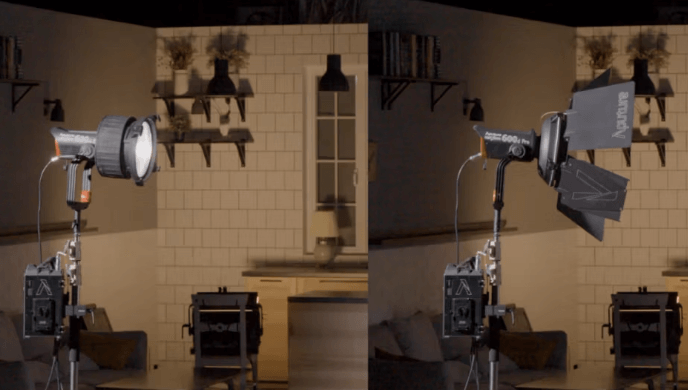
Aputure LS 600d Pro
The Verdict: If reliability and ecosystem integration outweigh budget concerns, Aputure remains the industry standard for independent film sets. The LS 600d Pro is a monster designed to replace traditional 1200W HMI lights.
It is the first Bowens Mount LED to feature a comprehensive weather-resistant design, allowing usage in rain or dust. While it may be “overkill” for a small home studio, it is an irreplaceable tool for professional crews shooting on location.
Output (3m w/ F10) 29,300 Lux
CRI / TLCI ≥96 / ≥96
Weatherproofing Dust & Light Rain
Ecosystem Sidus Link, LumenRadio
The Pros
- Immense Brightness: 8,500+ lux at 3 meters with Hyper Reflector.
- Weather Resistance: Safe for unpredictable outdoor shoots.
- Battery Charging: Can charge V-Mount batteries when plugged into AC.
- Control: Sidus Link is the industry’s most robust app.
The Cons
- Price: A significant investment for hobbyists.
- Weight: Lamp head is 4.64kg; requires heavy-duty C-stands.
- Noise: Active cooling is efficient but audible at max power.
Side-by-Side Comparison
To visualize the differences between these lights, we have compiled their key laboratory metrics below. Please note that “Lucas’s Pick” is based on specific workflow needs.
| Feature | Zhiyun Molus G200 | GVM Pro SD200B | Aputure LS 600d Pro |
|---|---|---|---|
| Power Output | 200W (Max 300W) | 200W | 600W (720W Draw) |
| CCT Range | 2700K – 6500K | 2700K – 6800K | 5600K (Daylight Only) |
| Color (CRI/TLCI) | ≥95 / ≥97 | 97+ / 97+ | ≥96 / ≥96 |
| Control | App (Bluetooth), Controller | App (Mesh), DMX-512 | Sidus Link, DMX, LumenRadio |
| Unique Feature | One-press MAX Mode (Overclocking) | 10-Hour Data Stability Aluminum Alloy Body | Weather Resistant Battery Charging |
| Lucas’s Pick | Best for Travel / YouTubers | Best for Interviews / Studio | Best for Film Crews / Rental |
Summary: Which Light Fits Your Workflow?
There is no single “best” light, only the right tool for the specific job. Based on our independent analysis:
- For Travel & Small Spaces: Choose the Zhiyun Molus G200. Its power-to-size ratio is currently unbeatable, provided you can manage the fan noise in Max mode. It is perfect for creators who need to pack light.
- For Professional Interviews & Color Critical Work: Choose the GVM Pro SD200B. The high CRI/TLCI (97+), DMX support, and robust aluminum build offer a “pro” experience at a competitive price point. It is the stable workhorse for long shoots.
- For Large Productions & Harsh Environments: Stick with the Aputure LS 600d Pro. Its weather resistance and massive output make it the standard for crews who need to fight the sun or shoot in the rain.