Amaran Halo 300x Video Light: A Senior Gaffer’s Field Report for 2026
The amaran halo 300x video light has maintained a significant presence in the professional lighting market since its launch. As we move through 2026, the landscape of digital cinematography has evolved, with newer sensors and more demanding HDR workflows. Being a senior gaffer with years of experience on high-stakes sets, I frequently receive messages from upcoming cinematographers asking if this specific unit still holds up against the newer flood of LED options. To give a definitive answer, I took the Halo 300x through a series of demanding tests in diverse environments to see if its performance remains a “must-have” for the modern kit.
Lighting technology moves fast, but the physics of light remains constant. In 2026, while many lights claim high output, few balance color fidelity, build quality, and ease of use as effectively as the Halo series. This field report explores how this 300W-class fixture handles the rigors of modern production.
Table of Contents
Types of Studio Lights: From Massive HMIs to 300W Precision
Early in my career, “big production” meant trucks loaded with 2.5K and 4K HMI lamps. These units were the backbone of the industry, capable of punching through windows and creating daylight where none existed. However, they were heavy, required specialized power distros, and generated immense heat.
Today, the shift toward efficiency is absolute. The industry has embraced 300-watt LED units as the versatile workhorses of the contemporary studio. A light like the amaran halo 300x video light provides the same usable punch as a traditional 575W HMI or a 2K Tungsten Zip light but with a fraction of the power draw and footprint. We no longer need a crew of four to move a single key light; the 300W class has democratized high-end lighting, allowing for “big production” results on indie-sized budgets.
Continuous Light vs Flash Photography
The divide between videographers and photographers has largely vanished in 2026. Most hybrid creators now prefer continuous light over traditional strobe/flash systems. While flash photography still offers unparalleled motion-freezing capabilities, continuous LED lighting provides the essential “what you see is what you get” workflow.
Using the Halo 300x allows a photographer to sculpt shadows in real-time, observing exactly how the light wraps around a subject’s features. For high-end portraiture and commercial work, the flicker-free performance of modern LEDs ensures that whether you are shooting at 1/50th or 1/8000th of a second, the exposure remains consistent.
RGB Video Light vs Bi-Color Video Light: Making the Right Choice
A common question I get is whether to invest in an RGB (Full Color) light or stick with a Bi-Color unit like the amaran halo 300x video light. While RGB lights offer creative flexibility for background washes and neon effects, they often sacrifice raw luminance and color accuracy in the white light spectrum.
Bi-color lights are engineered for one primary purpose: high-quality skin tones. The Halo 300x focuses its entire LED array on the 2,700K to 6,500K range. This results in significantly higher output than an RGB light of the same wattage. When you need to fight the sun or light a large softbox, the sheer “punch” of a dedicated bi-color fixture is irreplaceable. For professional work where skin tone reproduction is the priority, bi-color remains the gold standard.
Types of Video Light: The Advantage of the COB Design
In 2026, the market is split into several types of video lights, including panels, tubes, and COB (Chip on Board) fixtures.
- Panel Lights: Great for quick soft fill but lack the ability to throw light over long distances.
- Tube Lights: Ideal for practicals and in-frame aesthetics.
- COB Lights: The amaran halo 300x video light falls into this category. By concentrating many LED chips into a single, small point source, it mimics the behavior of a traditional bulb. This allows for precise control through modifiers like fresnels or reflectors, making it the most versatile tool for a gaffer.
Artificial Light Photography: Creating Atmosphere
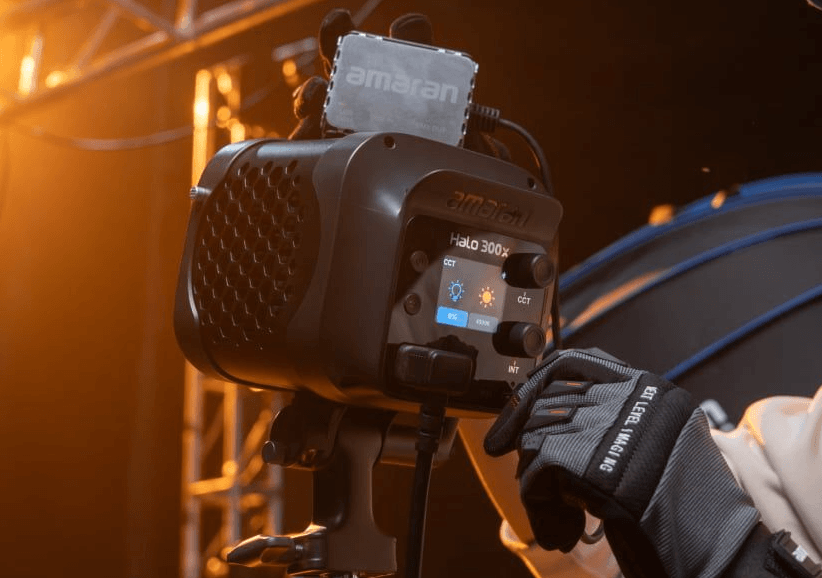
Artificial light photography is an art of control. In a studio, you are the master of the sun. The Halo 300x, with its impressive CRI of 96+ and TLCI of 97+, ensures that the colors of fabrics, products, and skin tones are rendered with total accuracy. The ability to fine-tune color temperature means you can create a warm, sunset-lit interior or a cold, clinical laboratory environment with a quick turn of the independent CCT knob.
Portable Video Lights and Studio Durability
While designed for the studio, the Halo 300x is one of the most capable portable video lights in its class. Its all-in-one design—with the power supply integrated into the lamp head—eliminates the “ballast clutter” that plagues other 300W lights. For location gaffers, this means faster setup times and fewer cables on the floor.
Technical Performance and Specifications
To understand why the amaran halo 300x video light is so highly regarded, we must look at the hard data. It offers class-leading brightness and a robust build quality that stands up to the 2026 competitive landscape.
| Feature | Specification |
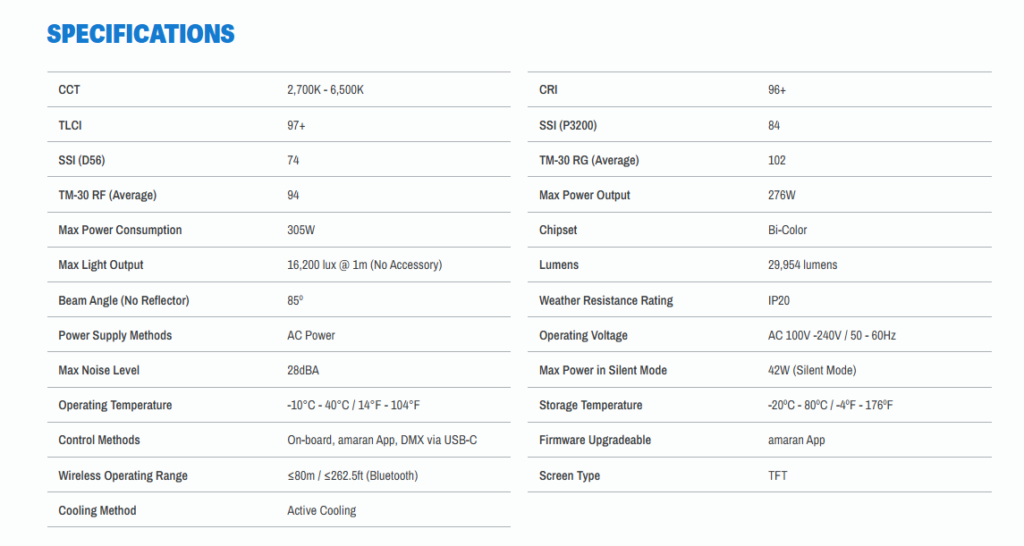
| CCT Range | 2,700K – 6,500K |
| CRI / TLCI | 96+ / 97+ |
| Max Power Consumption | 305W |
| Max Light Output (Bare @ 1m) | 16,200 lux |
| Beam Angle (No Reflector) | 85º |
| Control Options | On-board, amaran App, NFC, DMX via USB-C |
| Cooling | Active Cooling (28dBA) |
| Weight (Fixture) | 2.30kg / 5.07lbs |
Detailed Photometric Data (Halo 300x)
| CCT | Distance | No Accessories | Reflector | Fresnel (Spot) |
| 3,200K | 1m | 14,600 lux | 47,200 lux | 135,100 lux |
| 4,300K | 1m | 16,200 lux | 52,600 lux | 151,100 lux |
| 5,600K | 1m | 16,120 lux | 52,600 lux | 151,300 lux |
Real-World Usage: The “No-Modifier” Secret
Most gaffers will tell you that a bare COB light is “too harsh” for portraits. Usually, they are right—hard light creates unflattering shadows and hot spots. However, the amaran halo 300x video light has a unique advantage. Its native 85-degree beam angle and optimized chip placement allow it to perform exceptionally well even without softboxes or diffusers.
During a recent high-profile interview shoot in a very small office, there was no room for a 90cm Light Dome. I chose to use the Halo 300x bare. By angling the light to bounce off a white corner or simply utilizing its wide native spread, I was able to achieve a soft, wrap-around light quality that looked remarkably natural. Because the light outputs 16,200 lux bare, I had more than enough headroom to bounce the light and still maintain a comfortable T-stop on the camera.
This “no-modifier” capability is a game-changer for solo shooters and run-and-gun crews. You can walk onto a set with just the light and a stand, and by understanding the 85-degree spread, you can create cinematic images without the bulk of traditional softboxes.
In conclusion, the Amaran Halo 300x remains a top-tier choice in 2026 for those who prioritize reliability, power, and color precision. Whether integrated into a DMX-controlled studio or used as a portable powerhouse on location, it delivers the professional results that high-end clients expect.