Before landing on any specific fixture, most creators shopping for an amaran Halo 300x bi-color LED light have already settled one bigger question: continuous LED versus flash. For studio video, livestreaming, and multi-take shoots, continuous light has the edge — what’s visible on the monitor is what lands in the frame, with no recycle time or sync speed to manage between setups. The Halo 300x sits in that category, built specifically for dedicated studio use rather than as a general-purpose travel light.
What the amaran Halo 300x Offers
The Halo 300x is a true monolight — power supply and lamp head combined into one body, running off a single AC cable with no separate ballast box or extra cable run. Its all-metal build and full-size Bowens mount target studios that prioritize long-term reliability and repeatable results over ultra-light travel weight.
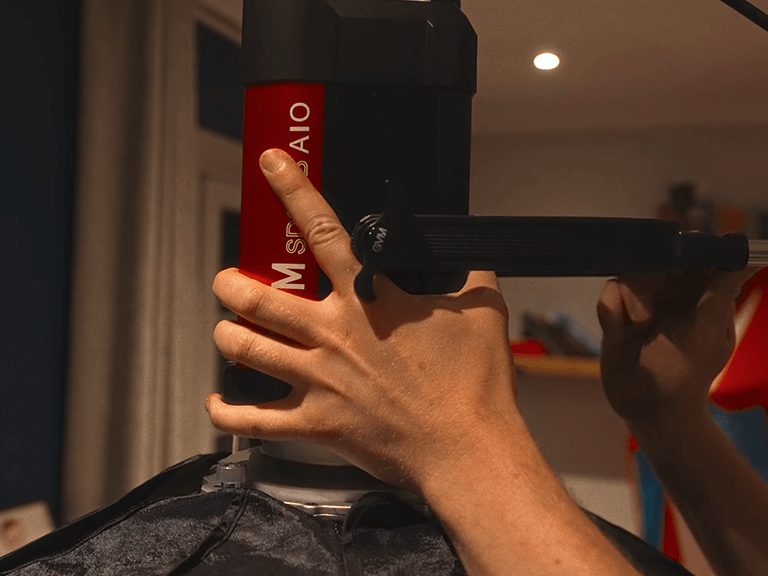
Color output spans 2,700K–6,500K bi-color, rated at CRI 96+ and TLCI 97+, with TM-30 figures of RF 94 and RG 102 backing up its color fidelity and saturation. Physical brightness and color temperature knobs sit directly on the housing, letting operators make adjustments without navigating a touchscreen menu mid-session — a detail aimed at fast-moving studio days. For studios running DMX, the Halo 300x connects via an optional USB-C to 5-pin adapter, extending it into console-based cue workflows alongside its own app and on-board Bluetooth control, rated for a wireless range up to 80 meters.
Rated output sits at 276W max power (305W consumption), reaching up to 16,200 lux at 1 meter with no accessory attached, or up to 52,600 lux at 1 meter with a reflector fitted. At 2.30kg for the fixture alone, it leans toward a fixed studio mount rather than a bag carried between locations daily. Active cooling manages heat through longer sessions at a maximum noise level of 28dBA, and a silent mode drops power to 42W for sound-sensitive recording.
amaran Halo 300x: Full Specifications
| Feature | Specification |
|---|---|
| Max Power Output | 276W |
| Max Power Consumption | 305W |
| Color Temperature | 2,700K–6,500K bi-color |
| Color Rendering | CRI 96+, TLCI 97+ |
| Max Light Output | 16,200 lux @ 1m (no accessory) / 52,600 lux @ 1m (with reflector) |
| Lumens | 29,954 lm |
| Beam Angle | 85º (no reflector) |
| Control Methods | On-board knobs, amaran App, DMX via USB-C |
| Wireless Range | ≤80m (Bluetooth) |
| Cooling | Active cooling, 28dBA max / 42W silent mode |
| Mount | Full-size Bowens mount |
| Weight | 2.30kg (fixture only) |
| Power Supply | Integrated, single AC cable |
How It Compares to a 300W AIO Alternative: the GVM SD300B
Creators evaluating the Halo 300x often cross-shop it against other integrated 300W bi-color monolights, and the GVM SD300B AIO is a common comparison point in that bracket. The two take different approaches to the same wattage class.
On brightness, the published numbers diverge substantially: amaran’s own photometrics put the Halo 300x at roughly 52,600 lux at 1 meter with a reflector attached, while GVM lists the SD300B AIO at 221,950 lux at 1 meter with its standard reflector. That’s a large gap on paper, though reflector design and each brand’s test methodology aren’t identical, so the difference is worth verifying against independent reviews rather than treating either number as a universal constant.
On control, the two differ in what they prioritize. The Halo 300x leans on physical knobs for fast manual adjustment plus optional DMX for console-driven studios. The SD300B AIO leans on app-based control with multi-light linking, aimed more at solo creators coordinating several fixtures from a phone. Color accuracy is close between them — CRI 96+/TLCI 97+ on the Halo 300x versus CRI ≥97/TLCI ≥97 on the SD300B AIO — a difference unlikely to be visible in most footage.
Build quality and price positioning also diverge: the Halo 300x’s all-metal housing, TFT screen, and DMX-over-USB-C put it toward the premium end of the 300W category, while the SD300B AIO’s app-first, accessory-inclusive approach (quick-deploy softbox, dedicated Fresnel, and projection attachment options) targets a lower price point for the same power class.
GVM SD300B AIO: Full Specifications
| Feature | Specification |
|---|---|
| Power | 300W |
| Brightness | 221,950 lux @ 1m with standard reflector |
| Color Temperature | 2700K–6800K bi-color, continuously adjustable |
| Color Rendering | CRI ≥97, TLCI ≥97 |
| Dimming | Stepless |
| Lighting Effects | 12 built-in (lightning, TV, candlelight, and others) |
| Control | APP remote control with multi-light linking |
| Build | All-in-one monolight design |
| Compatible Modifiers | Quick Deploy Softbox, CXT36 Projection Attachment, F40 Fresnel, DL65R Lantern Softbox (Bowens mount, max 300W) |
Which Fits Your Setup
Neither fixture is a clear win across every category — each is built around a different priority. The Halo 300x suits studios that already run DMX consoles, want on-board manual control without a phone in hand, and are willing to pay for an all-metal build. The SD300B AIO suits creators who want higher rated brightness and app-driven multi-light coordination without the DMX hardware investment. Checking current pricing and independent lux measurements for both before buying is the most reliable way to confirm which one actually fits a given studio or shooting style.
Conclusion
The amaran Halo 300x is a well-specified, studio-grade bi-color LED light with strong color accuracy, DMX flexibility, and a build aimed at repeatable, professional results. Whether it’s the right choice over an alternative like the GVM SD300B AIO comes down to workflow — DMX-console studios and hands-on manual control favor the Halo 300x, while solo creators prioritizing brightness headroom and app-based coordination may lean toward other options in the same 300W class.
FAQ
Q: What is the main advantage of the amaran Halo 300x compared to other 300W lights?
A: Its strongest advantage is studio integration — DMX compatibility, high color accuracy (CRI 96+, TLCI 97+), and consistent build quality designed for repeated professional use.
Q: Is the amaran Halo 300x good for solo content creators?
A: It can work well for solo creators who prefer physical controls on the fixture itself. However, if you prioritize maximum brightness or rely heavily on app-based remote control, other lights in the same power class may offer a better fit.
Q: Does the amaran Halo 300x support app control?
A: Yes, it works with the Sidus Link app for wireless control via Bluetooth, though its control ecosystem is less app-centric compared to some competitors.
Q: How does the amaran Halo 300x compare to the Nanlite FS-300B?
A: Both are solid 300W bi-color LEDs. The Halo 300x offers better DMX integration and slightly higher color accuracy specs, while the FS-300B is often lighter and more compact for location work. The better choice depends on your specific setup and workflow needs.