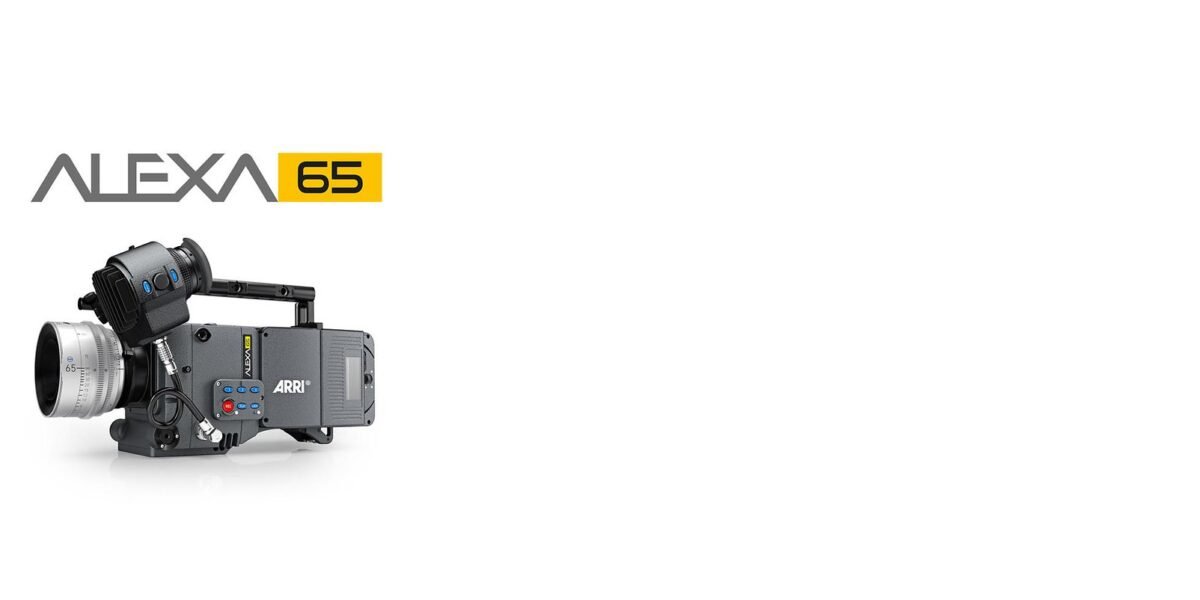
The Arri Alexa 65 is a 65mm digital cinema camera available exclusively through ARRI Rental, built around a 6560 × 3100 Open Gate sensor that delivers 14 stops of dynamic range and an active image area of 54.12 × 25.58 mm — roughly triple the sensor area of a Super 35 camera. It’s not a camera most productions can buy; it’s one they rent for a specific reason: a format large enough that IMAX selected the ALEXA 65 platform as its digital option for 2D IMAX productions.
This guide covers what the Alexa 65 actually is as a system — sensor, lenses, workflow — and, because that’s where most guides go vague, exactly how working DPs have lit for it on real productions, with the fixtures and technique choices that hold up against a 65mm sensor’s dynamic range.
Table of Contents
What the Arri Alexa 65 System Actually Includes
The Alexa 65 isn’t just a camera body — ARRI Rental supplies it as a matched system:
- Sensor and body: 6560 × 3100 Open Gate resolution, ARRIRAW capture, 14 stops of dynamic range.
- Lenses: the Prime 65 and Vintage 765 prime lens sets, plus the Zoom 65 — a 50-110mm zoom weighing 1.6kg that ARRI built with Lens Data System (LDS) integration, making it the only zoom in this format that reports metadata to the camera.
- In-camera ND: the IFM-65 system, a scaled-up version of the Alexa XT’s IFM-1, giving behind-the-lens full-spectrum ND (FSND) filtering across eight densities from ND 0.3 to ND 2.4 — avoiding the reflections that stacked external filters cause on Prime 65 and Vintage 765 glass.
- Media and workflow: 2TB SXR capture drives, supporting over 40 minutes of recording at full 6560×3100 resolution and 60fps uncompressed capture at that resolution, offloaded through ARRI’s Vault S and Vault XL Lab 65 systems.
- Monitoring: Viewfinder Smooth Mode (shared with the Alexa SXT line) and Smart Zoom, a programmable feature that lets an operator zoom into any one of five preset areas of the Monitor Out image for focus checks.
That system-level detail matters because it defines what the camera needs on set: consistent color across LDS-tagged glass, ND handled in-camera rather than stacked, and enough storage throughput to support long, uninterrupted takes at full resolution.
Why the Alexa 65’s Sensor Is Unforgiving to Bad Light
At 54.12 × 25.58 mm, the Alexa 65’s sensor is large enough that three lighting problems surface immediately, where they’d be absorbed on a smaller format:
- Shallow depth of field exposes uneven falloff. A key light that isn’t perfectly diffused shows up in soft-focus backgrounds as visible hot spots, not a gentle blur.
- 14 stops of dynamic range reveals color error in skin. Fixtures with a green or magenta tint pass a quick glance on a monitor but fail the moment skin tone is compared across a cut, because the sensor is recording detail most cameras clip.
- The format rewards restraint over output. Emmanuel Lubezki, ASC, AMC shot The Revenant on the Alexa 65 using golden-hour natural light, 12×12 diffusion frames, and negative fill from black cloth — almost no frontal key at all.
Arri Alexa 65 Films: What DPs Actually Did On Set
The Alexa 65’s track record is documented, not anecdotal — here’s what specific cinematographers did with it:
Greig Fraser, ACS, ASC — Rogue One: A Star Wars Story. Fraser ran the Alexa 65 as main-unit A, B, and C-camera simultaneously, which forced tight color-matching across three bodies. A soft, large-source key was the technique that held consistent lighting across all three cameras at once.
Pete Romano, ASC — Mission: Impossible – Rogue Nation. While the film was shot primarily on 35mm by Robert Elswit, ASC, Romano captured the underwater sequence on Alexa 65 with Prime 65 lenses inside HydroFlex housings, using LED and HMI sources with Kelvin values corrected for the underwater environment — a reminder that the shooting environment shifts color temperature more than the camera does.
Stuart Dryburgh, ASC, NZCS — The Great Wall. Dryburgh used the Alexa 65 as A and B-camera on main unit, ahead of Rogue One‘s adoption of the format.
Anthony Dod Mantle, ASC, BSC, DFF — Snowden; Trent Opaloch — Captain America: Civil War; Phedon Papamichael, ASC — The Huntsman; Florian Ballhaus, ASC — Allegiant: Part 1. Each used the Alexa 65/Prime 65 combination for selected sequences requiring the format’s specific image quality, rather than as their primary camera throughout.
Lighting Principles for the Arri Alexa 65
Target CRI ≥ 97 and TLCI ≥ 97 at both 3200K and 5600K. This isn’t a marketing threshold — it’s the point at which LED fixtures stop showing green/magenta bias against the Alexa 65’s color science. ARRI’s own SkyPanel S60-C is built to this standard; Aputure’s 600x and Nanlite’s Forza/PavoTube lines are commonly used alternatives that meet it as well.
Oversize your diffusion. A 120cm+ softbox or a 4×4 to 6×6 ft butterfly frame is standard; in large venues, that frame can grow to 8×8 ft, which raises output requirements (see the equipment section below).
Use negative fill as your primary contrast tool. Black flags, floppies, and duvetyne control the sensor’s contrast more predictably than adding fill light does.
Set color temperature on set, not in the grade. The camera’s LDS system logs focus, iris, and zoom metadata per take — it has no relationship to color. Mixed color temperature has to be caught and corrected live.
Judge exposure with false color, waveform, and a vectorscope — not the EVF. Smart Zoom and Viewfinder Smooth Mode are focus tools; they’re not built for exposure judgment.
Matching Lighting Output to Alexa 65 Shooting Conditions
Most Alexa 65 setups favor restraint — but restraint only works when the space is small enough for it. Once the diffusion frame grows past roughly 6×6 ft, or the key has to punch through 10+ feet of air in a large venue, output stops being optional and a compact panel can’t deliver enough clean light through that much diffusion to hold CRI 97+ at the subject.
For that scenario specifically — not as a general recommendation — a high-output, all-in-one COB fixture like the GVM 1200B AIO (1200W, CRI 97+, 2700K–6800K, 42,800 lux at 3m with the standard reflector, 10kg with no external ballast) fills the gap: enough output to properly load an 8×8 ft frame at distance, without the case-weight penalty of an HMI package.
Example: shooting an interview inside a university arena, an 8×8 ft frame was run off a single 1200B AIO at roughly 14 ft throw, 70% power, 5600K to match daylight bleeding in from upper windows — keeping the subject two stops over ambient without a second fixture, and clearing standard airline checked-baggage weight limits as one case.
Common Lighting Mistakes on Alexa 65 Sets
- Treating a low-CRI or low-output panel as adequate simply because it “looks fine” on a small monitor
- Mixing LED brands without verifying color match with a color meter
- Judging exposure from LCD/EVF brightness instead of waveform or false color
- Stacking front-mounted ND filters on Prime 65 or Vintage 765 glass instead of using the IFM-65’s behind-the-lens FSND system
- Over-lighting skin until the sensor’s texture detail disappears
Conclusion
The Arri Alexa 65 earned its place on Rogue One, The Revenant, and The Great Wall not because of raw sensor size alone, but because DPs matched their lighting discipline to what the format actually reveals — high-CRI sources, oversized diffusion, negative fill, and color decisions locked on set rather than fixed later. The one exception is scale: large venues need enough clean output to fill an oversized frame, which is where a fixture like the GVM 1200B AIO earns its place in an Alexa 65 kit. Ready to light a large-format shoot without an HMI-sized footprint? Explore the GVM 1200B AIO for 97+ CRI output that scales to an 8×8 ft key source.
FAQ: Arri Alexa 65
What sensor does the Arri Alexa 65 use?
A 6560 × 3100 Open Gate sensor with a 54.12 × 25.58 mm active image area and 14 stops of dynamic range, captured in ARRIRAW.
Can you buy an Arri Alexa 65, or only rent it?
It’s available exclusively through ARRI Rental — it isn’t sold as a standard purchase camera.
What films have used the Arri Alexa 65?
Confirmed productions include Rogue One: A Star Wars Story (Greig Fraser, ACS, ASC), The Revenant (Emmanuel Lubezki, ASC, AMC), Mission: Impossible – Rogue Nation (underwater unit, Pete Romano, ASC), The Great Wall (Stuart Dryburgh, ASC, NZCS), Snowden, Captain America: Civil War, The Huntsman, and Allegiant: Part 1.
Why does the Alexa 65 need higher-CRI lighting than most cameras?
Its 14 stops of dynamic range and large sensor area reveal color shift and uneven diffusion that smaller-format cameras and lower dynamic range tend to compress or hide.
What’s the IFM-65 and why does it matter for lighting?
It’s the Alexa 65’s behind-the-lens ND filter system, offering eight full-spectrum densities from ND 0.3 to ND 2.4 with neutral color balance — it lets a DP control exposure without stacking front filters that cause reflections on Prime 65 or Vintage 765 lenses.