Godox AD200 studio lights solved a problem that most travel and location photographers know well: full studio power without the bulk. Before the AD200 line existed, getting AD360-level output meant carrying a separate battery pack, a bulky flash head, and a mounting bracket just to fire one light. The original AD200 shrank all of that into something close to speedlight size, and the AD200Pro later refined it further. The question most photographers land on isn’t whether the AD200 series is worth owning — it clearly is — but which version actually fits how they shoot, and how it stacks up against the rest of the Godox lineup they might already own.
Why the Original AD200 Became a Travel Staple
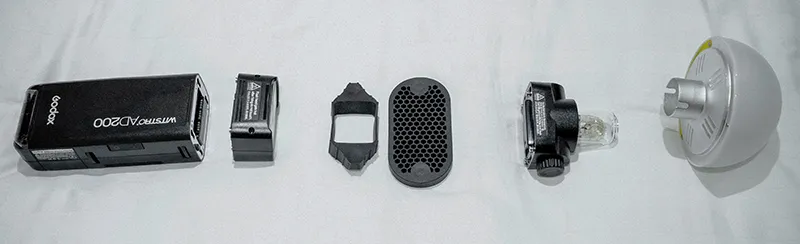
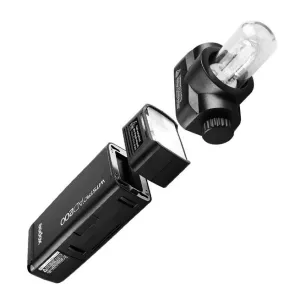
The appeal of the first-generation AD200 was never just the power output on paper. It was the interchangeable head system. Swap in the bare bulb head and it behaves like a mini AD360, spraying light 360 degrees to fill a softbox or umbrella evenly. Swap in the standard speedlight head and it throws a tighter, more directional beam without needing a separate reflector accessory. For anyone who previously carried an AD180 or AD360 plus its battery pack and Bowen S mount bracket, the AD200 cut the kit down to something that fits in a carry-on, while still using the same rapid box, beauty dish, and umbrella modifiers.
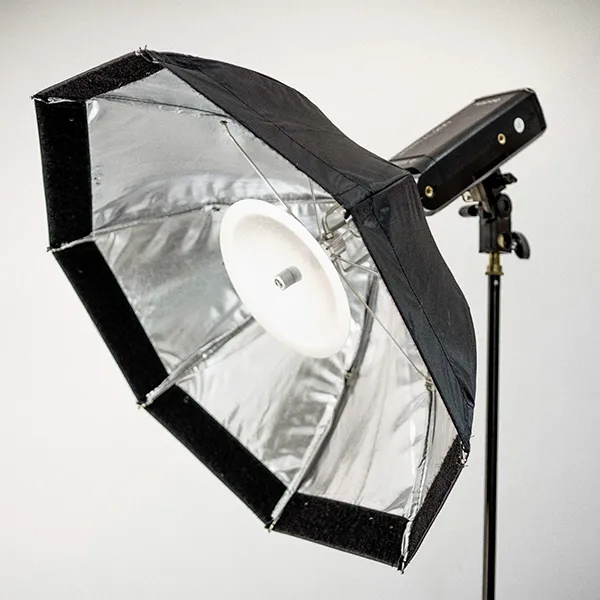
That flexibility is also why the AD200 became a common companion for wedding and event shooters. Bare bulb mode bouncing off a ceiling or wall gives soft ambient fill in a reception hall. A round diffuser dome turns it into a shoot-through-umbrella look that won’t catch the wind outdoors. And because it mounts directly to a light stand with minimal extra hardware, it’s realistic to set up and break down between venues without slowing a shoot day down.
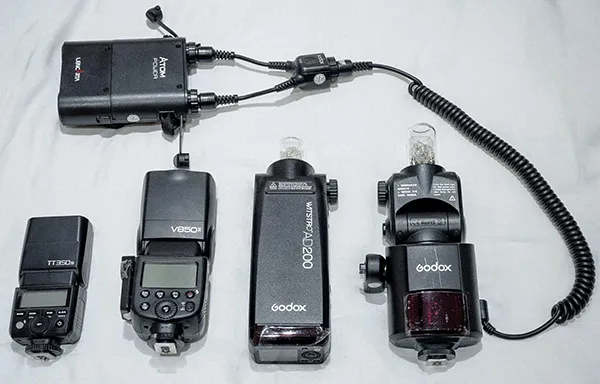
Placed next to the rest of the Godox lineup, the reasoning behind the AD200 becomes clearer. The Godox TT350 is smaller and lighter still, running on 2x AA batteries and fitting neatly on top of a compact camera as an on-camera flash or trigger — but its power output is a fraction of the AD200’s, so it works best as a backup light or a trigger for larger units rather than a primary source. The Ving V850II sits a step up, with a lithium battery and speedlight-style body, yet its fixed head shape means it can’t take the open-bulb modifiers — the rapid box, the beauty dish, the 360-degree spread — that make the AD200 useful for even fill. The AD360 solves that by keeping the open-bulb design and even edges out the AD200 slightly on raw power, but it comes back to the original bulk problem: a separate battery pack and bracket, plus extra reflectors if you want a controlled beam rather than an open spread. The AD200 sits at the point where those trade-offs meet in the middle — near-TT350 portability, near-AD360 light quality and modifier compatibility, without either one’s downside.
Compared with a standard speedlight — Godox’s own smaller units or third-party options like Yongnuo — the AD200’s case is even more direct: roughly three times the power output in a body that’s barely larger, a lithium battery instead of 4x AA cells for faster recycling and more shots per charge, a 3.5mm sync jack for older or manual cameras, and the option to run it as a bare bulb light or a standard reflector-head flash depending on the head fitted.
Godox AD200 vs AD200Pro: What Actually Changed
The AD200Pro isn’t a redesign — it’s a refinement of the same core concept, with the fixes photographers had been asking for. The biggest one is color consistency: the original AD200 could drift noticeably across its power range, while the Pro holds color temperature within about ±100K throughout the entire range thanks to a dedicated stable color mode. The Pro also moved to 1/10-stop power increments across a 9-stop range, added a USB-C port for firmware updates, and upgraded the flash holder to a more secure metal mount with a redesigned, recessed control panel.
| Spec | Godox AD200 | Godox AD200Pro |
|---|---|---|
| Power output | 200Ws | 200Ws |
| Power control | 1/1 to 1/256, 1-stop steps | 1/1 to 1/256, 1/10-stop steps |
| Recycle time | Up to ~2.1 sec | 0.01–1.8 sec |
| Flash duration | Up to 1/9,000 sec | Up to 1/15,380 sec |
| Color consistency | Not stabilized | ±100K across full range |
| Firmware updates | No port | USB Type-C |
| Wireless system | Built-in X system | Built-in 2.4GHz X system, 32 channels, 5 groups |
| Flash modes | Manual, TTL, Multi | Manual, TTL, Multi (up to 90Hz) |
| Battery | 2900mAh lithium, ~500 full-power flashes | 2900mAh lithium, ~500 full-power flashes |
On paper the power and battery life are the same. In practice, the tighter recycle time and stabilized color make the Pro noticeably easier to trust in fast-paced shoots where every frame needs to match.
Real-World Use Cases for the AD200 System
How the AD200 gets used day to day says as much about it as the spec sheet does. On UK shoots where cabin luggage isn’t a constraint, the open bulb head into a 60×60 softbox or a large umbrella is the default setup — full studio-style light without a mains-powered monobloc. On overseas trips, that scales down to a rapid box or beauty dish attachment, which is more compact to pack yet still gives a soft, flattering quality of light when worked close to the subject.
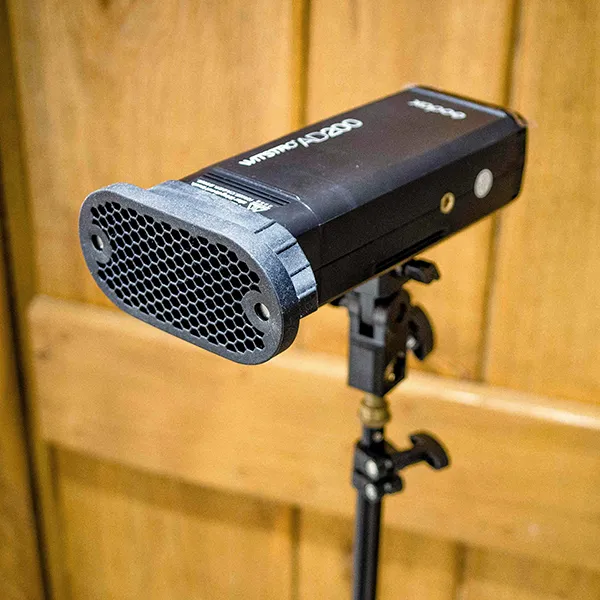
Bare bulb mode earns its keep at events: bouncing it off a wall or ceiling sprays soft ambient light around a room, which is a fast way to lift a reception hall without setting up a full light stand in the middle of the dance floor. For more controlled work, clipping a Magmod magnetic grid onto the standard reflector head narrows the beam into a spot, without needing to travel with bulkier studio-grade grids and reflectors. The white round head diffuser dome is another frequent choice for weddings specifically — it approximates a shoot-through umbrella’s softness but won’t catch the wind outdoors, and it doubles as physical protection for the bare bulb if the light gets knocked. And when shooting wide-open on fast primes, the built-in modeling light is bright enough to illuminate a face for accurate focus before the flash fires, which matters more than it sounds like when working in low ambient light.
For situations that need more than 200Ws from a single head, two AD200 units can be mounted together in a standard Bowen S bracket. Running the pair at half power each gives a faster recycle time than one unit at full power, while running both at full power suits larger modifiers — a parabolic umbrella, for instance — that need more raw output to fill evenly.
Godox AD200 vs Profoto B10: The Budget Angle
It’s hard to talk about compact battery flashes without the Profoto B1 and B10 coming up. The B10 in particular is often the closest point of comparison to the AD200, especially once the H200R round head is fitted to the Godox unit — visually and functionally, the two aren’t far apart. The real difference is price: the AD200 offers most of what photographers actually use the B10 for — wireless, battery-powered, compact, dual-head flexibility — at a fraction of the cost. For blue-sky-day flash work or wedding coverage where reliability and portability matter more than brand prestige, the AD200 covers the same ground, and the savings are large enough to put toward glass instead.
Which One Fits Your Shooting Style
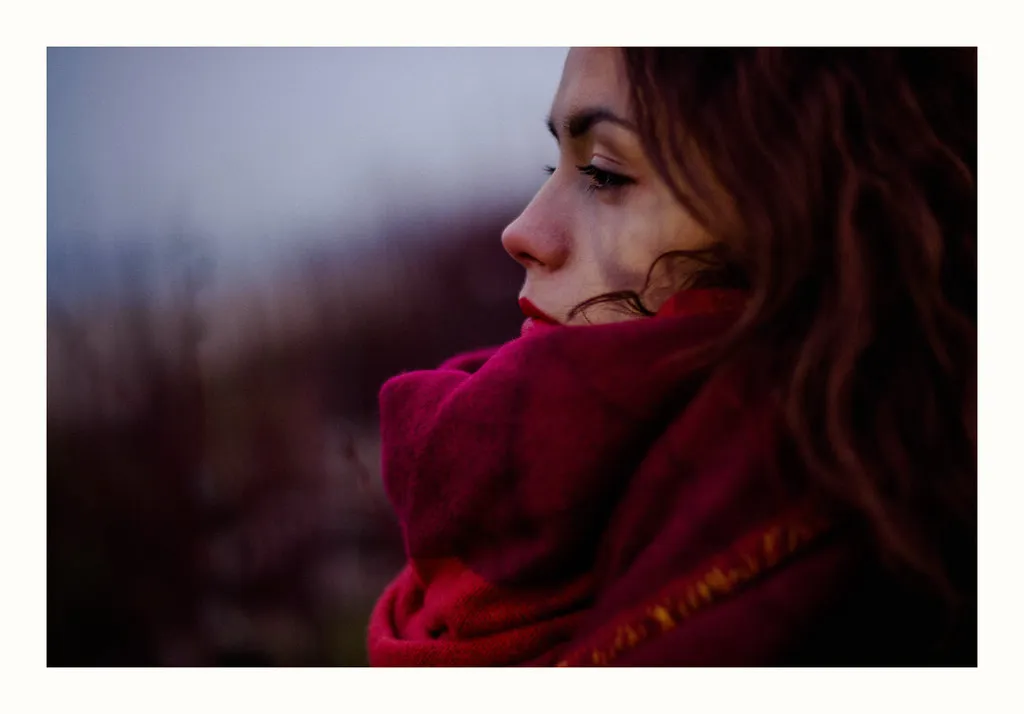
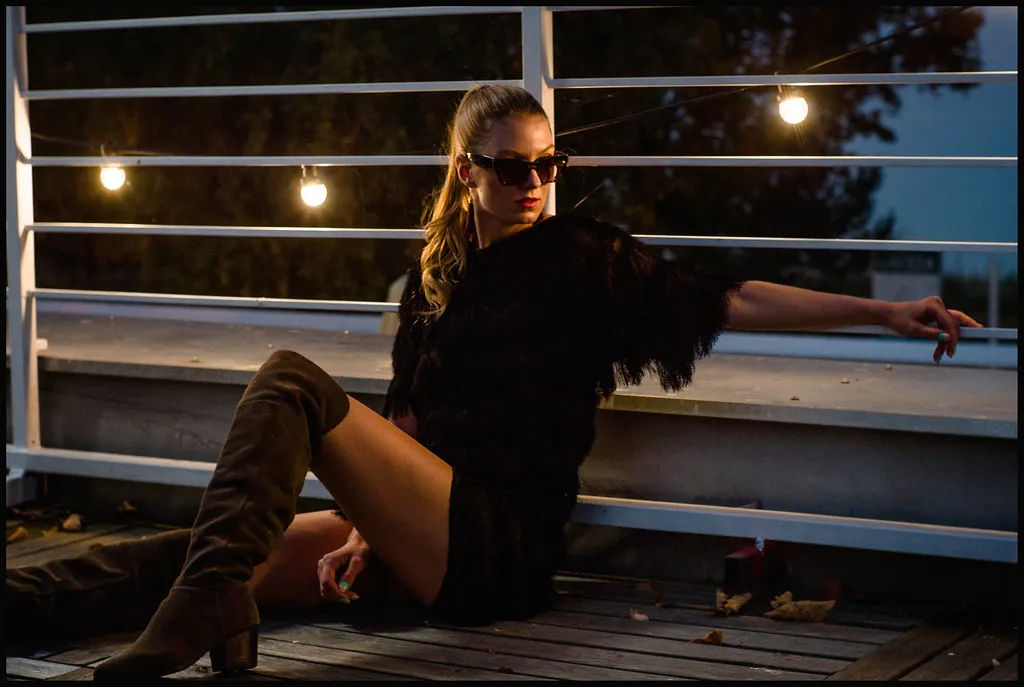
For a photographer shooting mixed lighting — daylight fill on location one day, indoor bounce flash for a reception the next — the AD200’s color drift can mean extra correction work in post. That’s where the Pro earns its keep: the stable color mode means a sequence of frames at different power levels won’t need individual white balance fixes. The faster recycle time also matters for anyone shooting fast-moving subjects, from event candids to action or fashion work, where waiting on a flash to catch up costs the shot.
The original AD200 still makes sense for photographers who already own one and shoot mostly single-power setups — a fixed portrait lighting ratio, for example, where color consistency across power levels isn’t being tested. It’s also the more affordable way into the AD200 head-swapping system if budget is the deciding factor and firmware updates or ultra-fast recycling aren’t priorities.
Compatible Modifiers and Triggers
Both versions share the same modifier ecosystem, which is worth knowing before choosing either one. Rapid box umbrella/beauty dish combos, silver and wide reflector heads, a round diffuser dome, standard and narrow snoots, a bulb protector, barn doors with gel kits, grids, and the round H200R head all mount the same way on AD200 and AD200Pro. An optional LED head attachment even lets the same unit double as a basic video light, and separate accessories can turn the AD200 into a power pack for a lightweight cable-connected head.
Triggers are similarly cross-compatible — the X1T and XT-16 wireless transmitters work with both, as do TT350 and Ving V850II units used as on-camera triggers, giving a photographer flexibility if they already own one of those. The one exception worth flagging: older FT-16/FTR-16 legacy receivers were never compatible with the AD200 line at all, though they do still work with the Ving V850II, so anyone migrating from an older Godox kit should check trigger compatibility before assuming everything carries over.
Conclusion
Godox AD200 studio lights earned their reputation by fitting studio-level output into a kit small enough for carry-on travel, and that core idea hasn’t changed between generations. The AD200Pro simply removes the rough edges — inconsistent color, slower recycling, no firmware path — that showed up once photographers pushed the original AD200 into faster, more demanding shoots. For most photographers buying into the system today, the AD200Pro is the safer long-term choice; the original AD200 remains a solid, lower-cost option for anyone whose shooting style doesn’t need the Pro’s tighter tolerances.